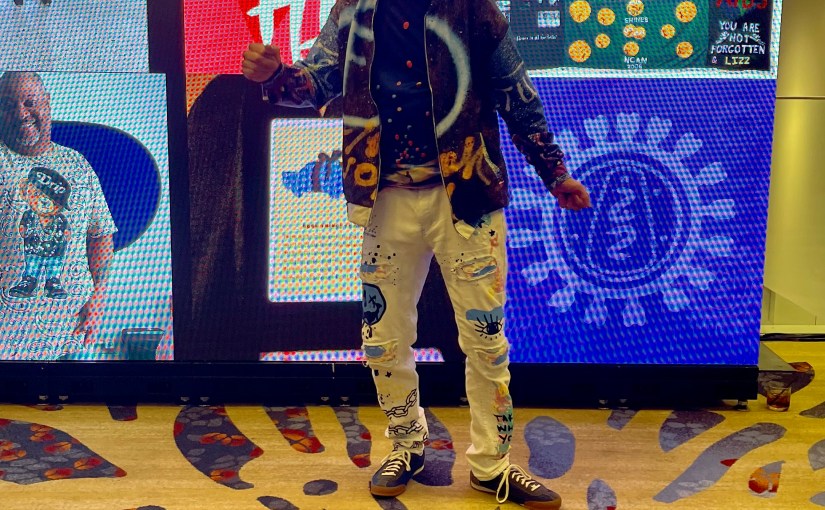
USCHA reminded me: gratitude is how we honor the fight, and responsibility is how we continue it!


What USCHA Taught Me About Legacy and Belonging

This was my first USCHA (US Conference on HIV/AIDS), and I wasn’t ready for it. I’ve been to HINAC (HIV Is Not a Crime) and AIDS Watch each twice, but this was different. There’s a magic at USCHA that gets under your skin.

I travelled to USCHA as part of NMAC’s 50+ Cohort, joining others like me from around the country who are aging and living with HIV. I’m grateful for the experience and the connections I made.

I’m 57. I’ve been living with HIV for 13 years. That’s my place in the timeline. Not better, not worse – just mine. But when I saw the decades of HIV/AIDS laid out at the Friday plenary, the science, the struggle, the survival – it cracked something open in me. For the first time, I felt the weight of what it means to be a long-term survivor. And I also knew that wasn’t me.

I came along after protease inhibitors, after HAART reshaped the fight. When I was diagnosed in 2012, my doctor told me, “The guidance is changing. We used to tell people to wait. Now we recommend you start treatment right away.” He still gave me the option – that’s how new it was. I didn’t understand then how historic that moment was. I do now.

In the 80s, I was a teenager. In the 90s, I was climbing the corporate ladder, coming out of the closet, largely disconnected from my community. By the time I came out, the epidemic wasn’t invisible anymore, but it was still tearing through our communities. The mid-90s would become the deadliest years. And while that grief was swallowing a generation, I was safe in my bubble, largely untouched, largely unaware. That’s the part that haunts me. The loss I didn’t live. The fire I didn’t feel.

So no – I don’t carry the same survivor’s guilt as those who were told they would die and somehow lived. My guilt is different. It’s the guilt of surviving in a post-HAART world, of being shielded by privilege, of waking up to a history I wasn’t part of, but which shaped everything around me.

At USCHA, no one made me feel like an outsider. But I did. I think people at USCHA saw me at 57 and assume I’m a long-term survivor. I’m not. I’m someone aging with HIV, without that same story. That difference is mine to wrestle with.

And yet, USCHA gave me clarity. It gave me a way to honor what came before me and what is still unfolding now. Because just as I look back in gratitude, I also look forward, knowing that those who come of age in the U=U and PrEP era will have their own place in history, too.

To say USCHA was “life-changing” sounds cliché. But this was something deeper. A reckoning. A reminder that every place in the timeline matters, including mine. And for that – for the people who came before me, for the community that still carries me forward – I am deeply grateful.

Keep telling the story,

Professor Peacock

Note: These are my thoughts and my story. I used AI to make helpful edits to my ramblings and online journaling.
Daily Checklist for Recovery-Centered Living


I’ve been thinking about some of the tools I learned about in early recovery. For me, my early years of recovery among the rooms of the 12 steps were foundational. I wouldn’t be where I am today without some of the guidance, tools and pearls of wisdom I received from others in the rooms – especially from my sponsors.

One of the habits I remember using was a daily checklist – kind of a mental intention for each day, that I would review at the end of each day.

The idea was on any given day, you strive to complete at least 3 items from the checklist. Not all of them. Just enough. This made the idea a lot more realistic on any given day.

I think I remember the five items – but feel free to substitute other things that work for you.

  1. Go to a meeting
  2. Talk to someone in recovery
  3. Read the (12-step) literature
  4. Do a spiritual practice (pray or meditate)
  5. Do a gratitude list

I could see journaling or self-care as useful for some. For others, it might be “Practice harm reduction.”

For spiritual practices, that could be praying, meditating, going to a church or other house of worship. Even as an agnostic Buddhist, I have access to prayer and meditation even though I may not choose to go to a worship service. And the Serenity Prayer is as much about living life as it is praying – it’s an addict’s friend.

I always knew at the end of the day, I could count on doing two things before bed – saying the serenity prayer and writing out my gratitude list. And if some days, I wanted to skip those I always could.

Anyway. You get the idea.

90 in 90 was another tool I used at several points in early recovery. I know I used it as I came out of my initial in-patient treatment. I know I used it years later after I relapsed. For me, it was a helpful tool.

For some, 90 in 90 may not be helpful. In those cases, I think this “3 of 5” approach using what works for YOU can be helpful.

I hope you find this helpful. Share your thoughts or suggestions in the comments. What 5 things would be on your list?

Vision Board 2023


Vision Board 101 – 2D

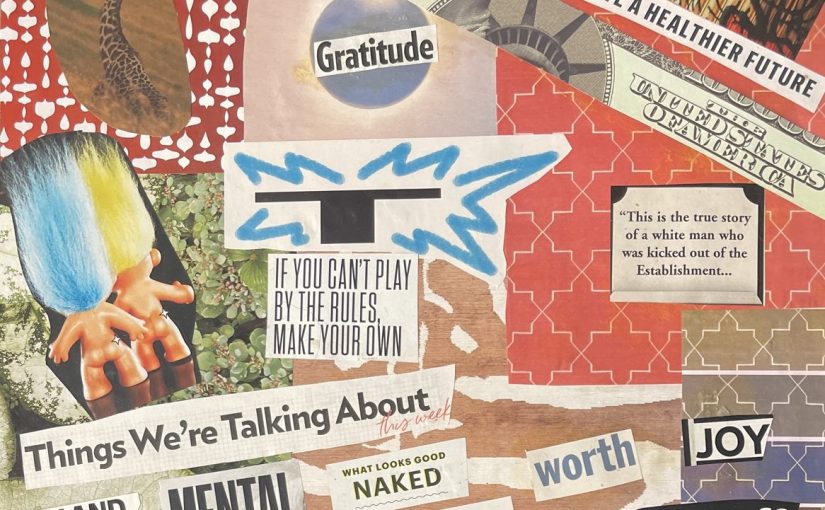
One of the traditions we’ve created at home is to create a vision board for the New Year. The basic starting point is a piece of cardboard. Yea, this is old school vision. boarding. And for this upcoming year, I present 2023.

I won’t expound on this. I simply share it with the Universe.

101 Resolutions for 2023

Vision Board 201 – An Infographic

The last couple of years, I’ve taken things to the next level in terms of a Personal Vision for the year.

Last year I chose 5 words for my year. They were “Be, Feel, Create, Learn, Grow.”

I had a flyer on my studio door and in my studio.

This year, I lifted the constraint and came up with my words for the year. They apply across all parts of me as a human being, a small business owner, an artist, an activist. It’s wholistic motivation for person-centric, trauma-informed living. That and $5 will get you a cup of coffee.

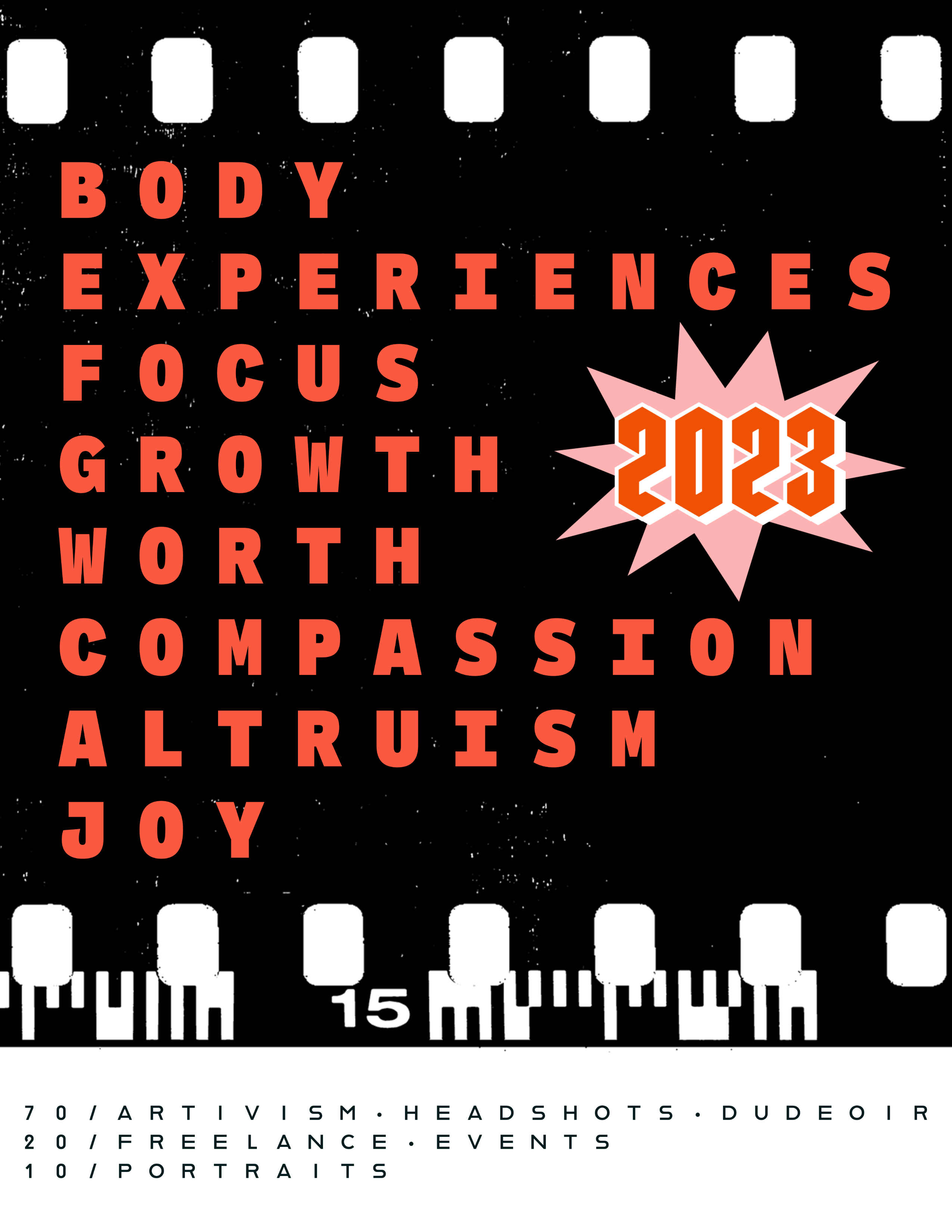
This year, I created an infographic. It will go on my studio door and in my studio.

Fancy.

Worth. Joy.

Having said that, my keyword for the year is Worth and my Why is Joy.

I created this infographic to motivate the troops (aka voices in my head) and keep my lean organization of one aligned.

Focus

My community focus continues to be on reducing stigma through my artivism. This includes my efforts linked to Celebrate UU, HIV Modernization Movement – Indiana, and community health, especially HIV & mental health. I’ll continue to blog here and through Professor Peacock.

For my business focus, I continue to use a 70/20/10 model to set priorities for the year. My keyword of Worth translates into focusing back on running a profitable business – something from which I stepped away the last 2 years due to my mental health & a subsequent artistic sabbatical…and a slowing coming back-tical.

Here we are, a new year with a Profit First mindset. Yes, I’ll read that book this year. Q1 even. Goal set.

My main studio focus with C Todd Creations this year will be headshots, although I’ll continue to freelance & do event photography when requested. I’ll also grow my speciality studio for dudeoir photography over at C Todd Dudeoir.

Thanks for listening.

Keep tellin’ the story,

Professor Peacock III