
Vision Boarding: creative art to identify and communicate one’s passions


I’ve been reminded of elements of my “personal brand” recently. These aren’t unique or even original. But, I knitted together my own thoughts and truths into a framework of living…a brand.  So far, in its second year, much hasn’t changed – which tells me it’s at the right level.

Large Corporations might need to create new objectives each year to keep their puppets motivated and focused on making shareholders money. But, my life isn’t that complicated. While change is a constant, I believe it makes sense to have some fundamental truths and beliefs which, while open to discussion and learning that might evolve or eradicate them, are nonetheless relatively constant compared to other daily activities or ongoing challenges.

When I first created my “brand,” I printed them and tacked them to the wall in my home office.  I then surrounded my wall clock and creative space with quotes, cards, photographs, letters, or other knick-knacks that meant something special to me. A letter from a friend during a tough time in my recent past; a birthday card from my mom, who died in 2013; a motivating front bulletin cover from Broadway UMC. These kept me grounded, motivated me, and called me to be myself and live fully.

While change is a constant, I also believe being flexible and “living in the grey” of life means changing things up a little, even if just to tell a story a little differently to keep things interesting. (I think I learned this at Broadway UMC, where we are often playing with certain elements of the service or their flow together…)

Turning that soft belief into action is something I owe to my partner Brandon. As a couple getting married in September, we have a lot of change going on – along with continuing to get to know each other and build a life together as a couple. I’m learning more about myself through the process, and at times, this process of living in harmony with someone tests my belief systems or lenses through which I see the world.

And that is a good and healthy thing, in my opinion.

So, being a little more right brained and creative, instead of finding more cards, letters, photos to tell my story or communication a vision…we went with magazine and newsprint clippings. Words, phrases, advertisements, tag lines, photos…all is fair game.  We kept things very high level, without timeframes or project plans.  It’s more conceptual, more spirit-led perhaps, and open to more interpretation and depth or difference of perception.

And it’s pretty fun to put together.

These are the three panels in my vision board.  It’s less “social justice” focused, and more personal – about passions, hobbies, high level motivation with some directional goals.  So, it’s “home” now at the office for a couple years until we shake it up again sometime…
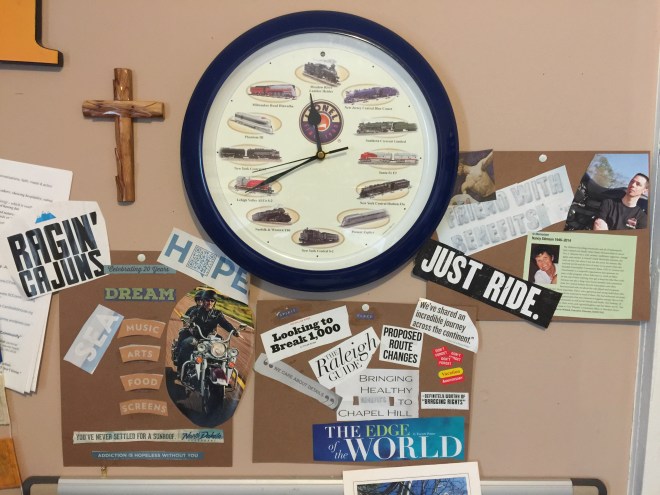
IMG_4251

Now, I think Brandon should teach “Vision Boarding” as a hands-on workshop at Trade School Indianapolis.  If you agree, please comment on this post so we can encourage Brandon to give it some consideration!

When asked “What are you good at?” the prostitute told the pastor “I’m really good with people…”


Sometimes I’m surprised by the dumb things people say.  Sometimes those things come out of my mouth.

This woman came to see me because she had to do community service for the court system. I asked her what her crime was and she told me “prostitution.”  Because I wanted to figure out what we could have her do around the church, before I could stop myself I found myself asking her “so, what are you good at?”  Her reply: “I’m really good with people.”

We put her to work providing hospitality to people who came to the building.  And she was really good at it!

Mike Mather

I love the way Mike tells stories – particularly when they help drive a point home with listeners. I wish I had 20% of his long-term memory and recall of details. But, I digress…

Mike gets some great questions. And some surprisingly dumb ones. But he generally finds a way to bring the story back around…

I love when he tells this story. Because it’s my story. But more importantly, it demonstrates in action how people I’ve come to call “neighbors” practice seeing people for who they really are – behind the stereotypes, labels and preconceptions we might put on those same people.

“Everybody has gift, yea sure. But what do you do with people who are mentally ill or who are drug addicted?”

Question from a visitor to Broadway

To hear the surprising response, I invite you to listen to Mike’s message. The juicy relevant pieces are in the beginning 4:33 minutes…

I probably would have lost my identity struggle with addiction as well as my identity as a contributing member of society had it not been for the simple acts of compassion I was shown – the friendships, the walks around the neighborhood talking, the new lens through which I’ve started to see myself and the world around me…

For that, I’m humbled and grateful. Thank you Mike, Rachel, Cathy, Karen, Kathy, Mike, Ann, Seana, Fran, Scott, Diane, Amy, MaryAnn, Cindy, Scott, Bill, Sue Ann, Mike, Mark, Chris, Holly, De’Amon, Terri, Greg, John, Sandya and many others…

Re-Entry and Early Recovery Resources in Indianapolis


I was recently approached by a friend who knew my story, and needed some information for a friend’s grandson about re-entry from incarceration and early recovery.  This is one of those times that “being open” about my story and past pays off – and strengthens my own recovery program.

I’ve been out of the direct realm of programs and organizations in this space since we shifted gears with Candlestick House.  I pulled together some details after confirming some contacts with friends who are closer to the action.  I thought I’d share it here…

Some of these resources are men-only, though most of them are gender-neutral 😉

Recovery Coaches

A Peer Recovery Coach is a person who provides support to individuals with alcohol and drug addiction issues. Recovery Coaching is the process of promoting ideas and actions that will give their clients the best chance for success in Recovery. This role has also been referred to as a Sober Coach, a Peer Recovery Specialist and Peer Recovery Support Specialist.

Sober Living Houses

Various options for a supportive living environment.  Usually a recommended step after detox/treatment.  Houses often have a leadtime/waitlist, so I’d contact them sooner than later.  All of these are good, solid houses with a long history in Indy.  No environment is perfect – so set that expectation.  But if the individual is willing, they are an important tool in early recovery.  

  • Talbot house
  • Progress house
  • Pathways – if dual diagnosed 
  • Salvation Army

Twelve Step Groups

NA or AA are available.  Some common recommendations:

ReEntry

Indianapolis has a “newer” movement around re-entry, where they are engaging people as they first enter jail/prison about coming out afterwards.  There is a video they share in-house, and there are resources / mentors to support people coming out.  

Contacts in this space:

Let me know if you have any questions.