
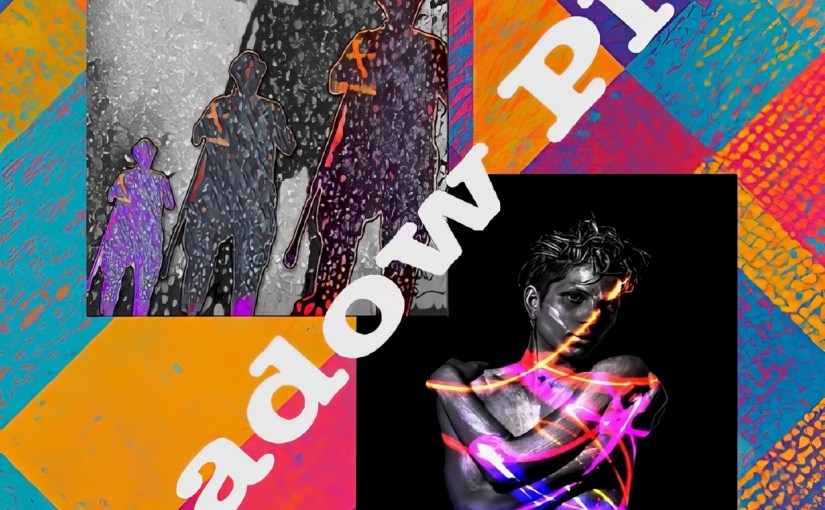
Shadow Play – Where bodies and cities meet in light and dark.
This exhibition brings together two queer artists who use shadow as both material and metaphor. Leslie Keith Shaw traces fleeting figures cast on sidewalks and streets, while Todd Fuqua creates digitally projected performances on the body itself. Together, their work transforms shadow into a space of queer joy, resistance, and play – blurring the line between public and intimate, concrete and flesh.
Finding Beauty in Unexpected Places
Art has always been a way to make sense of the world, to capture what might otherwise go unnoticed, and to transform struggle into something meaningful. For both artists featured in Shadow Play, creating images is not just about aesthetics. It is about survival, resilience, and finding joy where others might not think to look.
Leslie Keith Shaw has been making art in Indianapolis for more than two decades. His practice blends photography, scanography, and digital manipulation to transform everyday textures into vibrant, layered compositions. Sidewalk cracks, overlooked objects, and even items placed on a flatbed scanner become portals to hidden beauty. Living with HIV since 1987—a time when long-term survival was rarely imagined—Leslie approaches art as both sanctuary and celebration. Every piece is proof that life continues to hold mystery, meaning, and joy.
Todd Fuqua is a queer, non-binary photographer and visual storyteller based in Indianapolis who is also living with HIV. Their practice lives at the intersection of art and advocacy – what they call artivism. Through projects like #BLOOM, #CelebrateUU, and #ShadoWORK, Todd uses photography to explore identity, resilience, and liberation. Their imagery combines shadows, textures, and layered storytelling, with a strong emphasis on collaboration. Todd’s work challenges stigma, sparks dialogue about U=U and HIV criminalization, and celebrates the fullness of queer and marginalized lives.
What ties their practices together is a shared belief: that beauty and truth are always present, even if hidden at first glance. It could be a patch of sidewalk transformed into radiant abstraction. It could be a portrait layered with resilience and shadow. Both artists invite viewers to see differently. They encourage us to notice, to question, and to feel.
Together, their work affirms that art isn’t only about what is seen. It’s about what is discovered.
Call to Action
Join us for Shadow Play, a one-night pop-up exhibition on First Friday, October 4th, at 862 Virginia Avenue, Indianapolis. Step into an evening of light, shadow, and layered storytelling—an exploration of resilience, identity, and beauty in unexpected places. Don’t just see the art—experience the transformation.
Media Kit

FOR IMMEDIATE RELEASE
Shadow Play: Where Bodies and Cities Meet in Light and Dark
One-Night Pop-Up Exhibition | First Friday, October 3, 2025 | Indianapolis
Indianapolis, IN — This October, two Indianapolis-based queer artists will bring light, shadow, and layered storytelling to life in a one-night-only pop-up exhibition. Shadow Play opens Friday, October 3, 2025, at 862 Virginia Avenue (Mass Ave Knit Shop) in Fountain Square, as part of Indy’s First Friday gallery walk.
Shadow Play brings together the work of Leslie Keith Shaw and Todd Fuqua, two artists who use shadow as both material and metaphor. Shaw traces fleeting figures cast on sidewalks and streets, while Fuqua creates digitally projected performances on the body itself. Together, their practices transform shadow into a space of queer joy, resistance, and play – blurring the line between public and intimate, concrete and flesh.
For Shaw, who has been creating art in Indianapolis for more than two decades, overlooked textures – sidewalk cracks, discarded objects, even items placed on a scanner – become radiant abstractions. Diagnosed with HIV in 1987, Shaw’s practice is both sanctuary and celebration, proof that life continues to hold meaning, mystery, and joy.
Fuqua, a queer non-binary photographer and storyteller also living with HIV, works at the intersection of art and advocacy – what they call artivism. Through community-driven projects such as #BLOOM, #CelebrateUU, and #ShadoWORK, Fuqua layers photography, shadow, and texture to spark dialogue around stigma, resilience, and liberation.
What unites their work is a shared belief: that beauty & truth are always present, even if hidden at first glance. Whether drawn from the cracks of a city sidewalk or from the resilience etched on the human body, Shadow Play invites audiences to see differently—to notice, to question, to feel.
Event Details:
Shadow Play
First Friday, October 3, 2025
6:00 – 9:00 p.m.
Mass Ave Knit Shop: 862 Virginia Avenue, Indianapolis, IN 46203
Admission is free and open to the public.
The artists anticipate returning for November and December First Fridays, making Shadow Play an evolving installation across the fall season.
Press Contact:
C. Todd Fuqua
Email: todd@ctoddcreations.com | 317-847-1945
Event Website: https://bit.ly/ShadowPlayIndy
Media Kit: https://bit.ly/ShadowPlayMediaKit

 The Magical Storybook of Professor Peacock