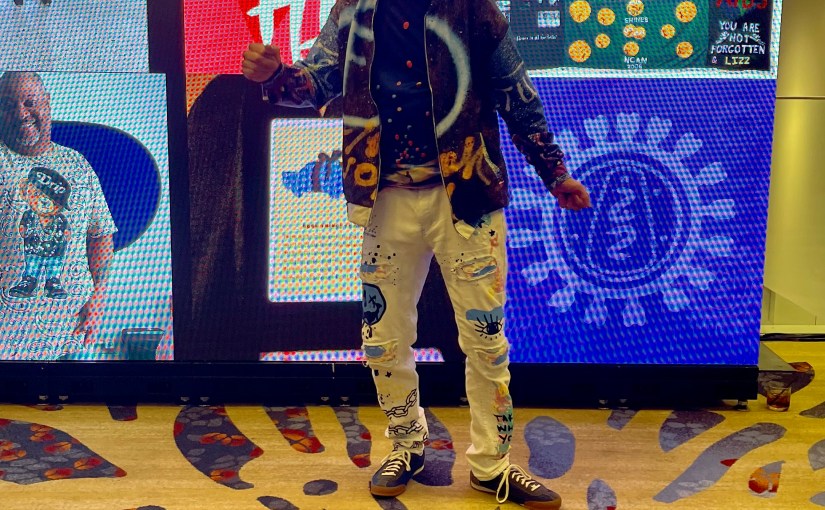
USCHA reminded me: gratitude is how we honor the fight, and responsibility is how we continue it!


What USCHA Taught Me About Legacy and Belonging

This was my first USCHA (US Conference on HIV/AIDS), and I wasn’t ready for it. I’ve been to HINAC (HIV Is Not a Crime) and AIDS Watch each twice, but this was different. There’s a magic at USCHA that gets under your skin.

I travelled to USCHA as part of NMAC’s 50+ Cohort, joining others like me from around the country who are aging and living with HIV. I’m grateful for the experience and the connections I made.

I’m 57. I’ve been living with HIV for 13 years. That’s my place in the timeline. Not better, not worse – just mine. But when I saw the decades of HIV/AIDS laid out at the Friday plenary, the science, the struggle, the survival – it cracked something open in me. For the first time, I felt the weight of what it means to be a long-term survivor. And I also knew that wasn’t me.

I came along after protease inhibitors, after HAART reshaped the fight. When I was diagnosed in 2012, my doctor told me, “The guidance is changing. We used to tell people to wait. Now we recommend you start treatment right away.” He still gave me the option – that’s how new it was. I didn’t understand then how historic that moment was. I do now.

In the 80s, I was a teenager. In the 90s, I was climbing the corporate ladder, coming out of the closet, largely disconnected from my community. By the time I came out, the epidemic wasn’t invisible anymore, but it was still tearing through our communities. The mid-90s would become the deadliest years. And while that grief was swallowing a generation, I was safe in my bubble, largely untouched, largely unaware. That’s the part that haunts me. The loss I didn’t live. The fire I didn’t feel.

So no – I don’t carry the same survivor’s guilt as those who were told they would die and somehow lived. My guilt is different. It’s the guilt of surviving in a post-HAART world, of being shielded by privilege, of waking up to a history I wasn’t part of, but which shaped everything around me.

At USCHA, no one made me feel like an outsider. But I did. I think people at USCHA saw me at 57 and assume I’m a long-term survivor. I’m not. I’m someone aging with HIV, without that same story. That difference is mine to wrestle with.

And yet, USCHA gave me clarity. It gave me a way to honor what came before me and what is still unfolding now. Because just as I look back in gratitude, I also look forward, knowing that those who come of age in the U=U and PrEP era will have their own place in history, too.

To say USCHA was “life-changing” sounds cliché. But this was something deeper. A reckoning. A reminder that every place in the timeline matters, including mine. And for that – for the people who came before me, for the community that still carries me forward – I am deeply grateful.

Keep telling the story,

Professor Peacock

Note: These are my thoughts and my story. I used AI to make helpful edits to my ramblings and online journaling.

When Depression Steals the Room


Depression doesn’t always arrive like a storm. Sometimes it slips in quietly, dulling everything it touches. The things that used to bring me joy – laughter with friends, coffee, a good conversation – drift out of reach. Colors wash away. The world shrinks into a small, cold corner where it’s hard to breathe.

It feels like a lifetime’s weight pressing me down into that darkness. I wake up heavy with years I didn’t ask to carry; every small hope becomes harder to lift. I feel alone and isolated, watching my life through glass. Friendships that once gathered now feel permanently distant. Family conversations thin into echoes. Simple pleasures scramble into things I can’t recognize. And there’s a voice that settles in: you are unworthy, insignificant, worthless. That voice is loud and mean and, in the silence, it feels like the only truth.

That loss doesn’t just hurt me. It hurts the people who love me, too. They watch helplessly from the outside, wanting to help but not knowing how. Their eyes ask questions they can’t answer, and I feel the weight of their worry alongside my own. Guilt spreads on both sides: I feel it for not being able to “just try harder,” and they feel it for not being able to make it stop.

Too often, depression is misunderstood as a choice, as if I could simply wish it away and rejoin the world. If only it were that easy. The truth is, depression is not weakness, laziness, or a moral failing. It’s an illness that isolates, confuses, and holds tight.

But here’s what matters: feeling powerless does not make me powerless. Speaking it, naming it, asking for patience – that is its own kind of strength. Depression hurts. It steals parts of me and makes me feel small. But I am still here. I am still reaching. I am still worth the light I hope will find me again.

Keep telling the story,

Professor Peacock

I Didn’t Relapse. I Chose to Use.


I’ve never loved the word relapse.

In abstinence-based recovery, it gets thrown around like a scarlet letter. Relapse means you failed. Relapse means you’re “back out there.” Relapse means you’ve lost your chip, your clean time, your credibility. It’s all-or-nothing, black-and-white, success-or-failure.

But here’s the thing: life isn’t black and white. And neither is recovery.

That’s where harm reduction has been such a gift to me. Instead of demanding perfection, it allows me to ask a more useful question: How can I reduce harm, no matter what choices I make?

When “Relapse” Becomes a Roadblock

The problem with calling it a relapse is the shame that follows. That shame can be louder than the actual use itself. I could spend a weekend beating myself up, convincing myself that I’ve ruined everything, that I should just give up. And ironically, that shame spiral is more likely to push me into more use – not less.

When I think about my own journey, relapse just doesn’t fit. Sometimes, yes, I make a choice that doesn’t line up with my intentions or my values. Sometimes I pick up something I’ve been avoiding. But that doesn’t mean I’ve suddenly undone all the progress I’ve made or that I’m back at zero. It means I made a choice – sometimes a healthier choice, sometimes a riskier one.

Harm reduction flips that on its head. It says: You’re still here. You’re still worthy. Let’s talk about what happened without judgment.

A Different Kind of Honesty

I want to be able to say:

  • “I chose to use because I was hurting.”
  • “I made a decision that didn’t line up with my values, and I want to unpack why.”
  • “I was stressed and slipped into an old pattern, but I’m not starting over at zero.”

That kind of honesty matters. Not because it excuses risky choices, but because it makes space to talk about them without fear. The real danger isn’t the choice itself. It’s the silence that stigma creates.

Words Like Overdose Don’t Always Fit Either

Even the language around risk needs reframing. “Overdose” implies I took too much. But often, the truth is scarier: I didn’t take what I thought I was taking at all. I may have signed up to use meth, but I didn’t sign up to smoke fentanyl. That’s not “overdoing it” – that’s contamination in a poisoned drug supply.

When we keep using the old language, we keep reinforcing old narratives: that the problem is the person, not the system. But if we reframe it, we see the truth. The real problem is unsafe supplies, criminalization, and a lack of support.

Moving Forward Without Shame

So I’ve stopped saying relapse. I’ve started saying: I chose to use.

That doesn’t make the choice “good” or “bad.” It just makes it mine. It keeps me honest without putting me in the box of failure. And it leaves room for growth, for reflection, for harm reduction.

I’m not back at square one. I’m still on the path. And maybe that’s the point: recovery, or whatever we want to call this messy, human process, isn’t about perfection. It’s about progress. It’s about staying alive. It’s about learning to meet ourselves where we are—without shame, without silence, and without that old, heavy word: relapse.

Keep tellin’ the story.
Professor Peacock

Note: These are my thoughts and my story. I used AI to make helpful edits to my ramblings and online journaling, including some organization to be more blog-friendly. AI created the featured image used in my blog.