
The data says fear-based stigma is growing fastest. At the same time, our laws and policy debates continue to signal danger in ways that may reinforce that fear.
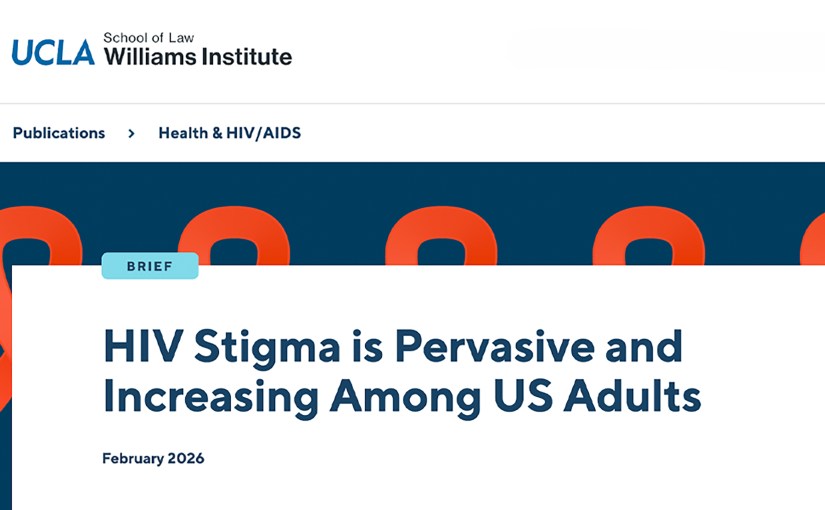
From 2021 to 2024, the share of U.S. adults holding at least one stigmatizing belief about people living with HIV rose from 31.5% to 43.0%. Fear-based stigma increased faster than blame-based stigma.
When outdated HIV criminal laws stay on the books, they send a message that science can’t erase: people living with HIV are still dangerous. I see the consequences of that message every day.
Law teaches the public who to fear.
Executive summary
The Williams Institute[1] found that HIV stigma among U.S. adults rose sharply from 2021 to 2024, with fear-based stigma rising meaningfully faster than blame-based stigma.[2] This matters because fear is the kind of stigma that gets written into policy, and recent institutional signals, including stalled legal reform and visible federal retreat from HIV commitments, may be feeding the fear rather than calming it.[2]
What the new data says
A February 2026 brief from the Williams Institute delivers a finding that should stop us cold: HIV stigma in the United States is increasing, not declining.[2]
From 2021 to 2024, the share of U.S. adults holding at least one stigmatizing belief about people living with HIV rose from 31.5% to 43.0%.[2] In 2024, about one-quarter of adults expressed blame-based stigma (26%), and nearly one-third expressed fear-based stigma (31%).[1]
But the increase is not evenly distributed.
The report describes two main forms of HIV stigma:
- Fear-based stigma is discomfort or avoidance rooted in exaggerated or inaccurate beliefs about how HIV is transmitted.[2]
- Blame-based stigma is belief that people with HIV are “immoral” or “blameworthy” and therefore “deserve” what happened to them.[2]
Both contradict modern science, including the basic reality that when a person living with HIV takes treatment as prescribed and gets and stays virally suppressed (undetectable), they do not transmit HIV to sexual partners.[3]
And one form of stigma is rising much faster than the other.
From 2021 to 2024, “blame-based stigma only” rose slightly (10.9% to 12.1%); “fear-based stigma only” rose more (12.8% to 16.8%). The share of adults endorsing both fear-based and blame-based stigma nearly doubled (7.8% to 14.1%).[2]
That pattern matters because blame is a moral judgment, but fear is a risk judgment.
Fear is the kind of belief that convinces the public they need “protection” from people living with HIV.
When stigma becomes law
The report says explicitly what too many public conversations avoid: fear-based stigma and blame-based stigma “run counter to scientific evidence” and still shape social and political conditions, including HIV criminalization and other structural discrimination.[2]
This is not theoretical. The Williams Institute notes that 32 states have laws that criminalize people living with HIV and 28 states impose enhanced criminal penalties tied to HIV status.[1] Indiana is in both of those numbers. The brief describes how many HIV criminal laws do not reflect current science about transmission risk and can criminalize conduct that poses negligible or no risk, such as spitting or biting.[2]
Here is the loop I cannot unsee anymore:
Stigma → shapes public attitudes → which shape law → which reinforce stigma.
A feedback loop.
Fear rarely grows in isolation. It grows in environments where institutions continue to signal danger.
The message laws send
There’s a piece of this that is hard to explain unless you live close to it. Laws do not just punish behavior. They tell stories about who is “risky,” who is “unsafe,” and who deserves special suspicion.
When HIV criminal laws stay on the books for decades after the science has changed, people living with HIV feel that. Even if enforcement is sporadic, the symbolism is constant.
And the message those laws send is hard to ignore:
You are still the monsters people were taught to fear in the 1980s.
I see this firsthand in our work with HIV Modernization Movement-Indiana.
For 10 years, we have worked to modernize HIV criminal laws in Indiana.[1] In that time we have achieved two significant legislative wins in 2020 and 2021, and one smaller penalty fix just this year in 2026.
But meaningful legal reform continues to stall in Indiana.
Our legislation has spent years bouncing between two chambers at the statehouse. Each session, it moves forward, then quietly gets redirected. From the outside, that looks like routine legislative gridlock. From the perspective of people living with HIV, it reads as a repeated institutional judgment: you are still dangerous enough that the law must keep treating you differently.
If you want to understand why fear-based stigma can rise even as treatment improves, start there.
Law teaches the public who to fear.
That is how fear-based stigma survives progress. Not because people have never heard “HIV is manageable,” but because their institutions keep teaching them “HIV is danger.”
Other possible drivers of rising fear
The Williams Institute brief documents the increase in stigma, but it is not designed to answer the “why now” question.[2]
I tried to think of some other reasons that come to mind from my advocacy work and interactions, in addition to the above analysis on the impact of outdated HIV criminal laws. Several other trends could explain fear-based stigma in particular.
One is the post-pandemic collapse in trust. When people distrust science and public health, they do not update their beliefs, even when the underlying facts change.
Another is plain HIV illiteracy. The science is clear, but the public’s mental framing is often stuck decades behind. Federal health agencies and providers still have to state, clearly and repeatedly, that people with HIV who are undetectable do not transmit HIV through sex. This is known as U=U, or Untransmittable is Undectable.[3]
A third driver is visibility that can unintentionally backfire. When HIV criminalization becomes more publicly discussed, the issue returns to the surface of public consciousness.
Government Signals and Public Risk Perception
The Williams Institute data stops in 2024. But the signals the current administration is sending now may shape what happens next.
When governments signal retreat from the HIV response, the public does not interpret that as progress. They interpret it as warning.
The White House issued an executive order in January 2025 directing a 90-day pause in U.S. foreign development assistance, pending review, with Office of Management and Budget enforcement through apportionment authority.[4]
Within the global HIV response, the policy debate has been especially loud around PEPFAR.[5] KFF reports that the administration’s FY 2026 budget request included $2.9 billion for bilateral PEPFAR activities, described as a $1.9 billion reduction.[6]
Even if some cuts are proposed rather than fully enacted, the social impact of the signal can be immediate: debate about shrinking HIV investment tells the public “this problem is getting less attention,” not “this problem is solved.”
Add symbolic erasure to that, and fear has fertile ground.
In late 2025, reporting indicated the U.S. government declined to mark World AIDS Day in the way it had historically.[7]
In February 2026, The Center for HIV Law and Policy’s Project Justice Partners workgroup published a statement framed around “defying erasure,” explicitly tying today’s HIV justice work to resisting silence and criminalization.[8]
Here is the backfire mechanism: When policymakers publicly debate cutting HIV funding or mute HIV awareness, they make HIV visible again. But visible as something the government is stepping away from. If the public already sees people living with HIV as risky, that retreat signal can be interpreted as: “They are going to be more dangerous now.”
The visibility, paradoxically, can amplify fear.
Policy decisions do more than allocate resources. They communicate priorities. When governments visibly debate cutting HIV funding, retreat from prevention commitments, or reduce public recognition of HIV awareness efforts, the public receives a signal about how seriously the threat is perceived.
For people whose understanding of HIV is already outdated, those signals can reinforce the belief that HIV remains a danger rather than a manageable condition.
Why this matters
Stigma is not a feelings problem. It is a public health problem.
The Williams Institute brief summarizes how stigma is linked to worse outcomes for people living with HIV, including poorer mental health, reduced engagement in care, and lower quality of life.[2]
Public health agencies also emphasize that HIV stigma discourages testing and accessing services.[9]
So when fear-based stigma rises, it is not just cruel. It is epidemic-fueling.
The challenge ahead
If fear-based stigma is rising, then the continued presence of HIV-specific criminal laws deserves scrutiny. Laws exist to address real harms and protect public safety. But they also send signals about how society understands risk.
When statutes continue to treat people living with HIV as uniquely dangerous decades after the science has changed, those signals can reinforce public fear rather than reflect current medical reality.
Over time, the gap between law and science can unintentionally sustain the stigma public health efforts are trying to reduce.
Next steps for advocacy messaging and strategy
Start treating fear-based stigma as a measurable communications failure, not a vague cultural problem:
- Lead with U=U in plain language and repeat it relentlessly, because fear thrives on ambiguity.[10]
- Pair that with a “law lags science” narrative that frames stalled reform itself as ongoing structural stigma.[2]
- Pre-bunk the retreat-signal effect by naming how proposed cuts and muted awareness days can be interpreted as rising danger.[6]
- Force accountability inside the legislature by making the bottleneck visible and concrete.
When law lags science long enough, the law itself begins to shape the fear it was originally meant to address.
The science has changed.
The people have changed.
Now the law (and the story it tells) must change too.
Keep Tellin’ The Story,
Professor Peacock
What are your thoughts on the reasons for this shift? Drop your ideas in the comments.
Note: The opinions expressed here are my own and do not reflect the views of HIV Modernization Movement–Indiana, the Williams Institute, or any other organization mentioned, unless quoted or attributed directly. This piece reflects my personal reflections and analysis. I used AI tools to help edit and organize my notes and online journaling into a more coherent, blog-friendly format.
Sources
[1] Williams Institute — HIV Stigma Is Pervasive and Increasing Among U.S. Adults
https://williamsinstitute.law.ucla.edu/publications/hiv-stigma-us/
[2] Williams Institute — HIV Stigma Is Pervasive and Increasing Among U.S. Adults (Feb 2026 Brief)
https://williamsinstitute.law.ucla.edu/wp-content/uploads/HIV-Stigma-Feb-2026.pdf
[3] CDC — HIV Treatment as Prevention
https://www.cdc.gov/hivpartners/php/hiv-treatment/index.html
[4] The White House — Reevaluating and Realigning United States Foreign Aid
https://www.whitehouse.gov/presidential-actions/2025/01/reevaluating-and-realigning-united-states-foreign-aid/
[5] Council on Foreign Relations — PEPFAR Has Saved Tens of Millions of Lives. Why Is It at Risk?
https://www.cfr.org/articles/pepfar-has-saved-tens-millions-lives-why-it-risk
[6] KFF — The Trump Administration’s Foreign Aid Review: Status of PEPFAR
https://www.kff.org/global-health-policy/the-trump-administrations-foreign-aid-review-status-of-pepfar/
[7] PBS NewsHour — Trump declines to mark World AIDS Day
https://www.pbs.org/newshour/show/trump-declines-to-mark-world-aids-day-as-funding-cuts-threaten-hiv-prevention-efforts
[8] Center for HIV Law and Policy — Defy Erasure, Defend Resistance, Disrupt Criminalization
https://www.hivlawandpolicy.org/news/defy-erasure-defend-resistance-disrupt-criminalization-positive-justice-project-partners-group
[9] CDC — Stigma and HIV
https://www.cdc.gov/hiv/health-equity/index.html
[10] CDC — Undetectable = Untransmittable
https://www.cdc.gov/global-hiv-tb/php/our-approach/undetectable-untransmittable.html



 The Magical Storybook of Professor Peacock
